
NACFB Cashflow Broker of the Year 2022

Best Broker for Short Term Lending

Highly Recommended as Best UK Commercial Broker
 Back to all media

September Business Update
Business News
The funding landscape has shifted again over the summer, and for both property investors and business owners the message is much the same. Borrowing costs are proving stickier than many hoped at the start of the year, and how a facility is structured now matters just as much as the headline rate. Here’s our round-up of where the market sits and what it means for you.
Market Update
Swap rates rose sharply through July 2026, with 2 to 5 year rates up 27 to 31 basis points, before settling with only modest further increases in August. The move reflects markets pushing back their expectations for Bank of England rate cuts, driven by stubborn inflation, a more hawkish tone from the Monetary Policy Committee and wider global rate pressures. For property investors, the result is materially higher fixed-rate pricing that now looks embedded into the market rather than temporary.
The immediate picture
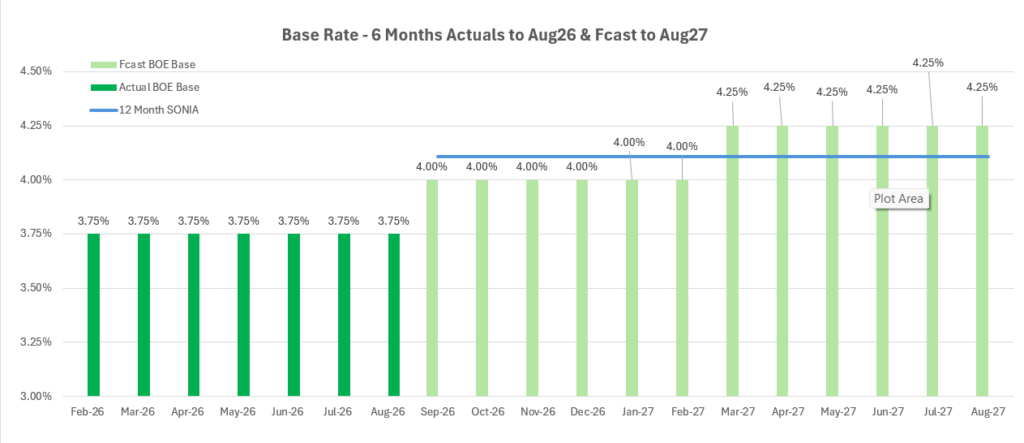
The Bank of England base rate is currently 3.75%. Over the quarter, the 12 month SONIA rate rose to 4.11%, which implies the market now expects two 0.25% rate rises over the next 12 months.
Longer-term borrowing costs
The picture over five years tells a similar story. Five year forwards have increased by 0.35% since June to 4.35%. With most Tier 1 investment lenders adding a margin of between 1.50% and 2.00%, that puts all-in borrowing costs at around 5.85% to 6.35%.

What’s driving the move
Several factors have combined to push rates higher. Services inflation has remained persistent, keeping the Bank cautious on cuts. The MPC’s more hawkish guidance repriced swap markets almost overnight. Higher government borrowing and gilt supply have dragged swap rates wider, particularly at the 2 to 5 year point. And with the Fed and Bank of England closely correlated since 2022, firmer US data has fed straight through into UK pricing. A resilient labour market, with steady wage growth, has only reinforced the case for rates staying higher for longer.
Navigating a moving market
The practical effect is that lenders pricing off SONIA swaps have re-marked their fixed products upward, with August confirming those levels rather than reversing them. The UK buy-to-let market has rarely felt more volatile as a result. Lenders are pulling and repricing products at a pace that would have been unusual even a few years ago, and what is available on a Monday morning is often gone by Wednesday afternoon. Pricing guides that were once updated monthly are now being revised weekly, or more often than that, and the gap between headline rates and what is actually available to a given applicant has widened.
This is precisely the environment where working with a specialist commercial finance broker adds the most value. At Pilot Fish we monitor the whole of the buy-to-let market in real time and carry out regular client portfolio reviews, assessing debt serviceability against the latest qualifying rates so that opportunities can be acted on quickly.
Business Finance Update
With markets now pricing in fewer rate cuts than we’d hoped at the start of the summer, the message for business owners is a familiar one. Borrowing costs look set to stay higher for longer, and that makes how your funding is structured just as important as the headline rate.
We’re continuing to see strong demand from businesses looking to move away from short-term, higher-cost facilities onto longer-term lending (loans and similar) that gives them room to breathe. Consolidation loans in particular are keeping us busy, rolling several facilities into one manageable structure to bring monthly costs down and simplify cash flow. Invoice finance also remains popular, freeing up working capital without adding pressure, and when used alongside longer-term lending it can create a much more balanced funding position.
We’re also seeing plenty of enquiries around management buyouts. It’s an encouraging sign that owners are planning ahead for succession and that management teams have the confidence to invest in the businesses they know best. With the right funding structure an MBO can be a smart, tax-efficient way to transfer ownership while keeping the business in safe, familiar hands. If a buyout is on the horizon for you, it’s well worth getting the conversation started early so the funding is ready when the timing is right.
If your facilities were put in place 12-18 months ago, the market has moved a long way since. It’s well worth a review to make sure your structure still fits where the business is now, and where it’s heading.
Is it time to review your funding?
Whether you’re reviewing a property portfolio or looking to restructure and grow your business, the right advice at the right time can make a real difference. With over 50 years of combined experience across property and commercial finance, our team is here to help you find a structure that works.
For property and investment finance, speak to John Shevlane on 07540 724000 or at john@pilotfishcf.co.uk. For business and commercial finance, speak to Ewan Clarke on 07354 848265 or at ewan@pilotfishcf.co.uk.
There’s no obligation, just a conversation.


